
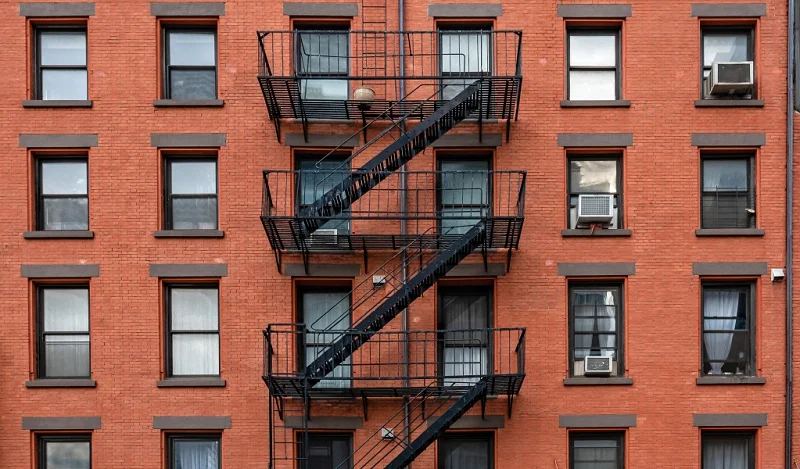
In the dense urban landscape of New York, Fire Escape Repair and Restoration Services in NYC are not just a matter of aesthetic upkeep, they are a critical legal and safety mandate for every building owner. Whether you manage a pre-war walk-up in Brooklyn or a commercial high-rise in Manhattan, your fire escape serves as the secondary means of egress, a lifeline that must be operational 100% of the time. Neglect here doesn’t just lead to Department of Buildings (DOB) violations; it creates a massive liability risk and endangers lives.
At the forefront of the pioneer construction niche, we understand that a fire escape is a complex structural system. From the counter-balance mechanism to the anchor points buried deep in your masonry, every component requires expert attention. This guide details the technical processes, regulatory requirements, and financial realities of maintaining these iron giants across NYC and Westchester.
Detailed Analysis: The Process of Fire Escape Restoration
Restoration is distinct from simple repairs; it is a holistic approach to halting corrosion and extending the lifespan of the metal. The primary enemy of any external steel structure in the Northeast is oxidation (rust), accelerated by the freeze-thaw cycles common in Yonkers and White Plains.
1. Scraping and Surface Preparation
The longevity of any paint job is determined by the preparation. We begin by removing loose rust and flaking paint. In many older buildings in The Bronx and Queens, this requires careful adherence to lead paint safety protocols.
- Hand Scraping vs. Needle Scaling: For delicate historic ironwork, hand scraping is preferred to preserve detail. For heavy structural steel, pneumatic needle scalers are used to blast away deep corrosion scales.
- Lead Abatement: If the existing paint contains lead (common in pre-1978 structures), we utilize wet scraping methods and containment tarps to prevent hazardous dust from contaminating the site.
2. Priming and Painting
Once the raw metal is exposed, immediate encapsulation is necessary.
- Rust-Inhibitive Primer: We apply a heavy-duty industrial primer (often red oxide or zinc-rich) that chemically bonds to the steel to stop rust creep.
- The Top Coat: The final layer is an enamel-based, weather-resistant paint. [INTERNAL LINK: Fire Escapes] experts often recommend a contrasting color for the top coat to ensure no spots were missed during application.
Detailed Analysis: Structural Repairs and Welding
While restoration handles the surface, structural repair addresses the integrity of the load-bearing elements. Over time, the connection points where the fire escape meets the building façade can weaken a condition known as “oxide jacking,” where rust expands and pushes steel connections apart.
Critical Repair Zones
- Tread Replacement: Rusted steps (treads) are the most common failure point. We replace these with new diamond-plate or bar-grating treads, welded securely to the stringers.
- Square Head Bolts and Rivets: Historic fire escapes in Mount Vernon and New Rochelle often use older square-head bolts. We inspect these for “necking” (thinning) and replace them with high-strength structural bolts.
- Cantilevers and Brackets: These are the supports that go into the wall. If the masonry around them has cracked (spalled), moisture enters and rots the steel from the inside. We perform “blind repairs” where we open the masonry, replace the rusted section of the beam, and re-brick the area to match the façade.
- Counter-Balance Mechanisms: The drop ladder must work seamlessly. We grease, balance, and load-test the counter-weight to ensure it lowers slowly and safely, rather than crashing down or getting stuck.
Regulatory Compliance and Code in NYC and Westchester
Navigating the regulatory environment is the most challenging aspect of property management in this region. Compliance varies depending on your building’s height and location.
NYC Local Law 11 (FISP)
For buildings taller than six stories in Manhattan, Brooklyn, Queens, and The Bronx, fire escapes are classified as “appurtenances” under the Facade Inspection and Safety Program (FISP), formerly Local Law 11.
- Cycle 10 Requirements: As of the current cycle, inspectors (QEWI – Qualified Exterior Wall Inspectors) must perform hands-on inspections of fire escapes.
- Defect Classifications: A fire escape can be marked as “Safe,” “Unsafe,” or “SWARMP” (Safe With A Repair and Maintenance Program). “Unsafe” conditions require immediate protection (sidewalk sheds) and rapid repair.
NYC Housing Maintenance Code
For buildings under seven stories, owners are still required to keep fire escapes free of rust and obstructions. The FDNY and DOB frequently issue violations for:
- Peeling paint (indicative of neglect).
- Clutter (plants, bicycles) on platforms.
- Immovable drop ladders.
Westchester County Codes
In towns like White Plains, Yonkers, and New Rochelle, while Local Law 11 may not apply strictly as it does in NYC, local fire codes (based on NY State Fire Code) mandate that all means of egress be maintained in safe working order. Fire marshals in these jurisdictions perform periodic inspections and will shut down buildings with compromised egress routes.
Cost, Longevity, and ROI Comparison
Building owners often ask: “Should I repair my fire escape or replace it entirely?” The answer lies in the Return on Investment (ROI) and the extent of the damage.
Option A: Restoration and Repair
- Cost: Moderate. Typically 15-25% of the cost of full replacement.
- Longevity: A proper scrape, weld, and paint job can extend the life of a fire escape by 10-15 years.
- ROI: High. It satisfies [INTERNAL LINK: Fire Escapes] compliance immediately, removes violations, and preserves the building’s historic character without the massive capital expenditure of fabrication.
Option B: Full Replacement
- Cost: Very High. Requires engineering drawings, major permits, fabrication of new steel, and crane operations.
- Longevity: 50+ years.
- ROI: Lower in the short term due to high upfront cost, but necessary if more than 30-40% of the structural steel has lost its section thickness due to corrosion.
The Verdict: For most owners in Westchester and NYC, a proactive restoration maintenance plan (every 5 years) is the most financially sound strategy.
Choosing the Right Contractor in NYC and Westchester
Not all general contractors are qualified to touch a fire escape. The risks involves working at heights, handling heavy steel over public sidewalks, and adhering to strict codes.
Key Qualifications to Look For:
- Specialized Rigger License: In NYC, any work involving hoisting or scaffolding requires a licensed rigger. Ensure your contractor holds the appropriate Master or Special Rigger license.
- Insurance Coverage: Standard liability insurance is often insufficient for exterior steel work. Look for [INTERNAL LINK: Fire Escapes] contractors who carry high-limit umbrella policies and workers’ compensation specific to high-elevation work.
- Local Expertise: A contractor familiar with Mount Vernon codes might not know the intricacies of a SoHo landmark district application. Choose a partner who has demonstrated success in your specific borough or township.
- Engineering Capabilities: The best contractors have in-house or partner engineers who can sign off on load tests and remove violations from DOB records efficiently.
Frequently Asked Questions (FAQ)
1. How often do I need to paint my fire escape in NYC?
While there is no strict timeline, the rule of thumb is every 3-5 years. However, if any rust is visible, you are technically in violation of the maintenance code. Periodic painting is cheaper than steel replacement.
2. Can I use my fire escape as a balcony?
Absolutely not. Placing chairs, plants, grills, or storage boxes on a fire escape is a major fire code violation in NYC and Westchester. It blocks the egress path and adds “dead load” that the structure wasn’t designed to hold permanently.
3. What is a “Load Test” and when is it required?
A load test involves applying physical weight to the fire escape (usually the drop ladder or cantilever) to prove it can hold the required capacity (often 100 lbs per sq ft). [INTERNAL LINK: Fire Escapes] inspectors or the DOB may demand this if there is doubt about the structural stability during an inspection.
4. Do I need a permit to repair my fire escape?
For minor scraping and painting, usually no (unless it is a Landmark building). For structural repairs involving welding or beam replacement, a DOB permit is generally required. Always consult your [INTERNAL LINK: Fire Escapes] expert to determine permit needs.
5. My building is in a Historic District. What are the rules?
If your building is landmarked (common in parts of Brooklyn and Manhattan), you must obtain a permit from the Landmarks Preservation Commission (LPC) before doing any work. The LPC often requires specific paint colors (usually black or brown) and prohibits altering the visual style of the ironwork.
Conclusion
Your fire escape is more than a metal appendage on your building; it is a shield against tragedy and a focal point for regulatory compliance. Whether you are dealing with a violation in The Bronx, a rusted staircase in Yonkers, or a FISP inspection in Manhattan, proactive maintenance is the only path to safety and savings.
Don’t wait for a violation to turn into a costly emergency. Secure your property’s future today.
Would you like me to analyze your specific property address to check for any open DOB violations or determine your specific Local Law 11 cycle eligibility